.jpg?w=360&h=360)

The age of ginseng directly affects its medicinal value. The longer it grows, the more abundant the accumulation of active ingredients. But how to judge its growth years through appearance? Mastering the following key features can help you get started quickly.
Look at the Rhizome (Lu Tou): The "Growth Rings" of Age
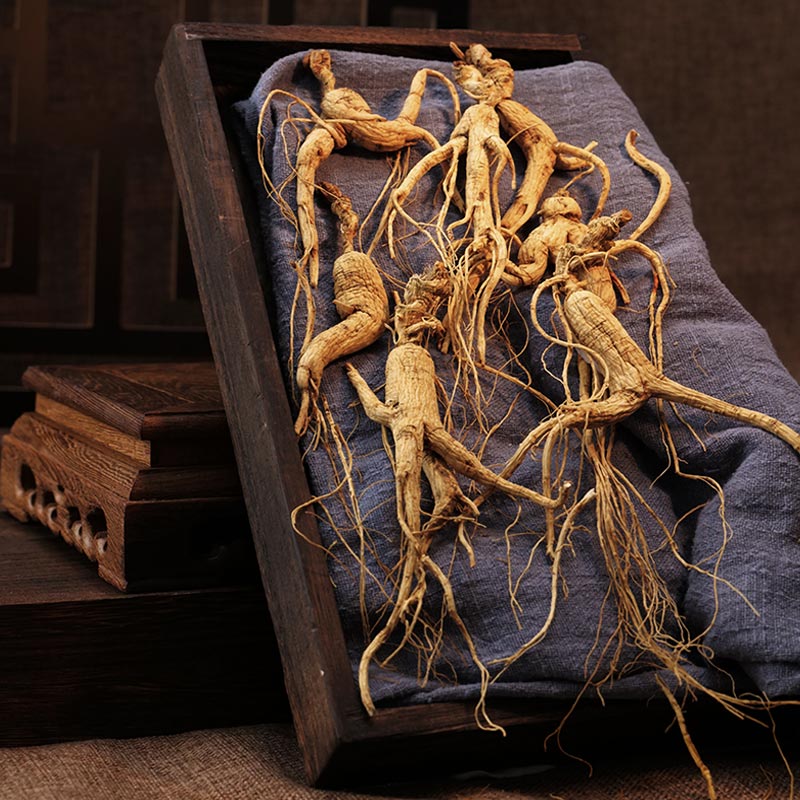
The rhizome (Lu Tou), the part with stem scars on the upper part of ginseng's rootstock, can be called the "living file" of its age. Every spring, ginseng will germinate new stems from the rhizome, and after withering in autumn and winter, a round or oblate stem scar (commonly known as "Lu Wan") is left.
- 1-3 years old: The rhizome is short, with few and indistinct "Lu Wan", usually 1-2.
Over 5 years old: The rhizome becomes longer with the increase of age, and the number of "Lu Wan" increases, arranged closely with clearer edges. For wild ginseng over 10 years old, the rhizome may show a "round rhizome" (the lower "Lu Wan" are blurred due to long-term growth and wear).
Observe the Main Root: Secrets of Shape and Texture
Ginseng with a longer growth period will show unique morphological characteristics in its main root:
- Shape: Ginseng under 3 years old has a thin and short main root, mostly cylindrical; over 5 years old, it gradually becomes thick and plump, with the upper part of the main root ("shoulder") widening to form a "broad shoulder", and even branching (commonly known as "legs"), with natural and stretched branches.
- Texture: The horizontal wrinkles ("iron wire lines") on the epidermis become dense and delicate with the increase of age, and most of them encircle the main root in a ring shape. The wrinkles of wild ginseng are deeper, as tight as old tree bark.
Check the Fibrous Roots: Signals of Slenderness and "Pearl Spots"
- Young ginseng (1-3 years old): The fibrous roots are short, thick, and few in number, with no obvious small spots.
- Over 5 years old: The fibrous roots become slender, flexible, and evenly distributed, and the surface will grow small white or light yellow bumps ("pearl spots"), which are the lateral root scars where ginseng absorbs nutrients. The longer the age, the denser the "pearl spots".
Note: The "Traps" of Artificial Intervention
Some artificially cultivated ginseng will forge the age by pruning the rhizome, splicing the root body, etc. It is necessary to judge by combining multiple characteristics:
- If the arrangement of "Lu Wan" is unnatural, or the thickness of the main root and fibrous roots is disconnected, it may be a spliced product.
- If the texture is too shallow or too regular, it may be a low-age ginseng grown by artificial acceleration.
Mastering these points, you can roughly judge the growth years of ginseng. Remember: Naturally grown old ginseng has a sense of coordination precipitated by years in every feature, which is difficult to replicate by artificial imitation.